
Embracing Disorder
Lessons from designing a new operating system from scratch
It stills amazes me to think I spent about half of my career at Google tucked away in an anonymous building on the fringes of the Mountain View campus working on a new, modern OS with a funny and difficult to spell name, Fuchsia. While cleaning up an old cabinet I found a zine the visual design team put together for that project and I remembered the designers jokingly put a priceless tag in the back of the cover. I couldn’t agree more. I feel like I joined this team with merely a high school diploma in Interaction Design and left it 5 years later with a master that, for better or worse, changed the way I think and practice my work.
Imagining, and then building, a new operating system from scratch doesn’t happen often and while it’s true most R&D projects never see the light of the day, you might have used bits of Fuchsia yourself if in the last couple of years you used some Google Nest hardware and with the latest rise of GenAI I have seen many ideas we explored blooming in devices and operating systems around us, a sort of tech and design zeitgeist, or an entanglement where teams without direct connections have been thinking about the same problems and dreaming similar solutions.
R&D projects could be explorations of alternative worlds, engineering and design what-ifs, that with enough follow-through might have the possibility of influencing the direction of products and infrastructures. From a design perspective exploring a new operating system meant the possibility to question and rethink many fundamental constructs of human-computer interactions. The specifics of the work are obviously confidential and also not really the point I want to make. I am more interested in explaining what I learned from this experience and what can be applied, in general, to system and infrastructure design.
So let’s use an analogy instead to tell this story.
The process of building cities from scratch
Imagine being an architect who gets to design a city from scratch (some actually do…). It sounds exciting and scary at the same time, maybe even naive (but we will talk more about this aspect later). Where to begin? How? Without constraints or specific requirements it is difficult to decide how to start. One approach might be to copy existing templates, pick cities we like, understand what we specifically like about them and recombine the elements in a new design, but this would give us evolutionary, perhaps derivative results. We could improve on some aspects of the design but we would be fundamentally following existing solutions. The alternative could be to work in isolation and focus on redefining what a city is, not what we already know a city to be, or what we think a city should be, but to redefine what it could be from the ground up, and let the design follow.
We thrive thanks to mental models that help us maintain handy shortcuts to what things are and how they work and as a bonus successful mental models are also shared so we have the benefit of knowing our shortcuts are understandable by others too. But here we are in a completely new territory, there is a vast plot of land in front of us and the drawing board is empty. We should first write our new definitions and hopefully they will inspire new mental models. For instance we could say a city is a place for people to accumulate and share resources; we are not assuming shapes or infrastructures yet, but we are imagining a purpose. In a city built for accumulating and sharing resources there could or could not be skyscrapers, cars, or shops. We don’t yet know if these things are needed for our city to be a city as we defined it.
With a purpose, we have verbs (accumulate and share) and we have a noun (resources). We can use these elements to dig deeper. What are the resources people need to be shared in a city? Food, water, shelter, knowledge, tools, skills perhaps? This list might not be exhaustive but these nouns could become some foundation for the next step in designing a city out of thin air. In our team we would call these stakes in the ground.
When everything could be a variable, you need to find a way to define and freeze some of them and use them as stubs from which to begin the design process.
Assuming food, water, shelter, knowledge, tools, and skills are our stakes in the ground now we know our city must be designed around them. We need structures to support the collection, storage, and distribution of these six types of resources. This is by no means comprehensive but it is enough to start sketching concrete ideas for how this city could be built and function.
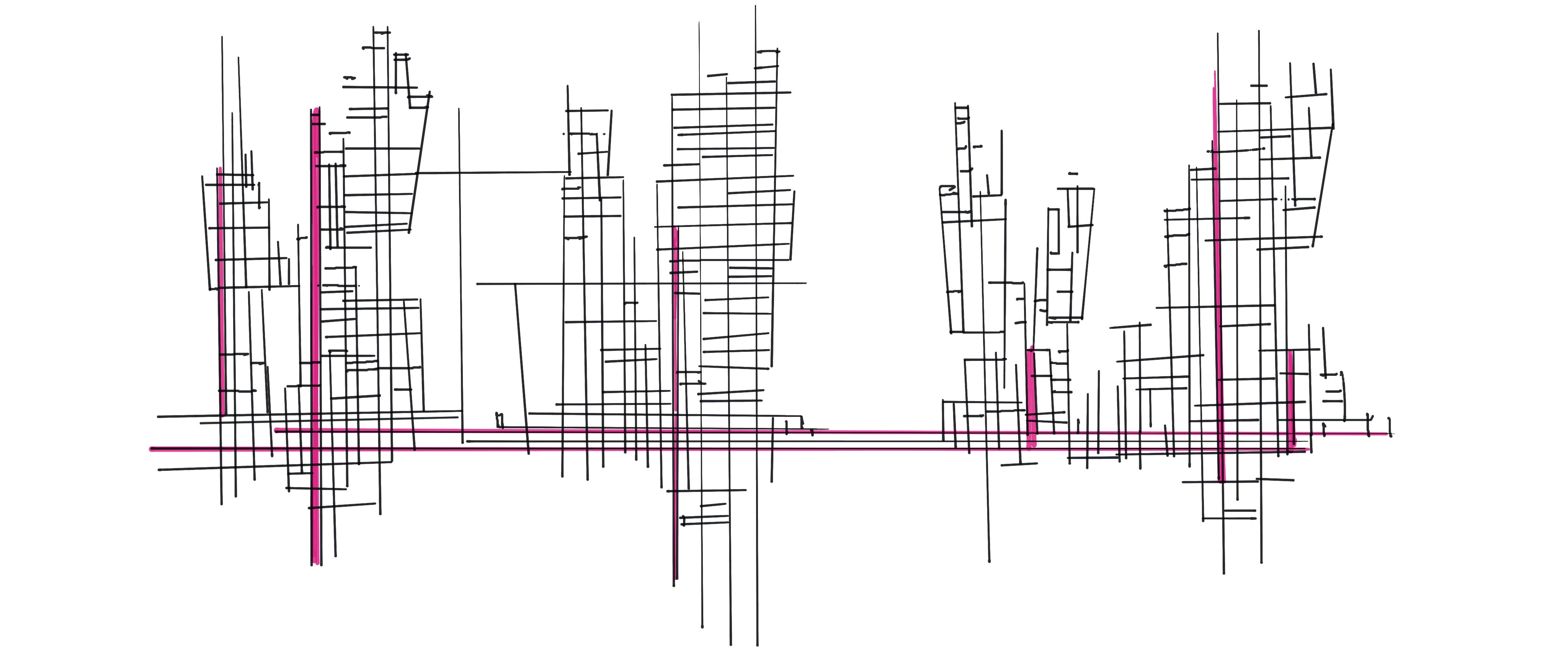
The way I described this process might seem very bottom-up, given the images I used around putting stakes in the ground and designing infrastructure around them, but it is in reality a very rigid, top-down approach, where I basically imposed my own personal definition of what a city might be and used it as the foundation of its design. You wouldn’t do this alone, most likely you would have a lot of people around you, each responsible for an aspect of the city, and you would have to negotiate the stakes in the ground, the language, and the design principles with them in order to make progress with the project.
This looks like a collective dream where everyone involved in the projects decides to take a pause from reality (the common, shared, known definitions and expectations of a city), and isolate in a different reality where a new, shared language provides an alternative definition of what a city could be. Given the scale of the project - Rome wasn’t built in a day after all - the group needs to commit to operating in this self-imposed dream state for a long while. I tried it for several years: it is both exhilarating and frustrating. You can see all the pieces of your imaginary city coming together beautifully, and you can also see how they won’t fit in the actual reality around you, at least at present or in the immediate future. It is both a communication and adoption problem: the mental models and the solutions you are developing are not compatible with others outside of the project and they would require both a massive (and unlike) cognitive and technical reset.
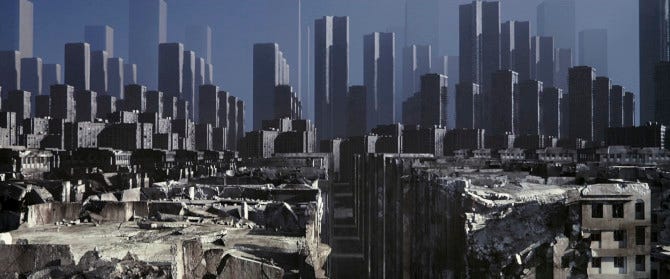
This approach to designing systems is both problematic and sometimes necessary. Designing in isolation is rarely a good idea and yet, if we strive for better cities, OSes, or any other systems we sometimes need to, at least temporarily, bend reality and believe something else is possible. The trick is in finding the productive balance between radical redefinitions and pragmatic solutions.
The disorder of complex systems
Cities are in fact fairly complex systems that cannot easily be reduced to a few nouns and verbs. They are the constantly evolving results of many small or large decisions made by countless different actors. These decisions are not only constantly happening but they are reverberating from the past and influencing the future directions of these systems. Are operating systems the same? Computers are by definition predictable, although they have reached incredible levels of sophistication they don’t display the unpredictability of complex systems, but the large platforms or systems we built with computers do. So in a strict technical sense an operating system is not a complex system, but in broader terms it enables many systems no less complex than cities.
Cities are an interesting analogy because through history there have been many attempts at redefining and building, measuring and controlling them, most recently in human history through the use of computers (A City is not a Computer: Other Urban Intelligences by Shannon Christine Mattern is a good read about this).
Richard Sennett described in his 1970 book The Use of Disorder how modernist city planners deadened cities with strict top down designs, and in more recent years in collaboration with Pablo Sendra (Designing Disorder: Experiments and Disruptions in the City) reiterated how complex systems do not exist in isolation; they cannot be created top-down by fiat and require embracing and designing for and with chaos—accepting that complex systems can only be steered, not fully designed or tamed.
Steering the reality, rather than designing in the isolation of an alternate reality involves dealing with imperfections and thinking about the infrastructure and conditions under which desired behaviors can naturally emerge.
You are no longer required to design a city from scratch - although we keep trying - and you don’t need to set stakes in the ground or have a fixed set of nouns and verbs. Rather, you are working with trajectories, levers, and pressure points to manipulate. The idea of a city as a place for people to accumulate and share resources becomes a series of questions around what are the most useful resources that should be shared among the city dwellers and how to incentivize sharing, rather than hoarding. The answer wouldn’t be singular but it could open up a host of small and large experiments and this is where the ideas of Designing Disorder struck me as a powerful insight even in my line of work. To make small and large experiments, and subsequent adaptations possible the focus of design should be on creating open, opportunistic, loose infrastructures that open up possibilities, rather than closing them.
Pablo Sendra has a simple, effective examples in a diagram where he shows the difference between allocating service outlets in a single corner of a public space (that’s the spot the planner designated as the temporary event area of the park) versus evenly distributing them, letting the future inhabitants of the space deciding the best spot for events and other activities. The space bends and adapts to its users, not the opposite. It is a tiny, almost invisible difference, and yet it changes the space dynamics and the role of the designers, from benevolent dictators to facilitators.
I don’t think I would have understood these concepts 5 or 10 years ago, nor had the desire for applying them. I confess I still sometimes feel the allure of an empty canvas in front of me for re-imagining from scratch whatever system I am designing. But as the world and the technologies around us are getting more complex, multi-faceted, and intertwined I think this is becoming a luxury I/we cannot afford.
Whatever city you are building, don’t design it isolated in an alternate reality.
References:
Christopher Nolan. Inception, 2010
Richard Sennett. The Uses of Disorder: Personal Identity and City Life. Knopf 1970
Not cited here but Jane Jacobs’ The Death and Life of Great American Cities and The City as a System, Metabolic Design for New Urban Forms and Functions are also great reads I hope to study more.
The cover photo is a detail of “Veiled Whispers” (2021) by Elias Sime